1st September 2010:
The London Underground may be out of service on Monday 6th and Tuesday 7th September. Our visitors are encouraged to avoid the Tube service on those days. Please see this link for more information: Proposed strike action.
These links are provided for the convenience of our visitors:
Conference Booklet
Transport Timetable
Maps of Exeter University
Catering Outlets
Exeter mini guide (Tourist information)
UK power sockets and plugs
Sports facilities
9th August 2010:
Bookings for the on-campus accommodation will close on Thursday 12th August so that we can finalise our arrangements.
29th July 2010:
The guest list for the conference dinner is now full. We regret to announce that any new registrants will thus be placed on a waiting list for the conference dinner.
10th July 2010:
If you have registered on this site and your registration has been accepted, but you have not completed the payment stage yet, please do it urgently by following this link.
A few spaces remain to attend the conference, if interested please fill in the registration form, wait for acknowledgement, and then fill in the payment form.
28th June 2010:
Posters will be displayed pro-eminently near the conference room and participants will be able to read them during the coffee and lunch breaks.
The poster size will be up to A0 size in portrait (width = 841mm, height = 1189mm), or up to width=841mm in landscape.
14th June 2010:
Flying from the USA? Click here for some trip advice.
Conference Aims
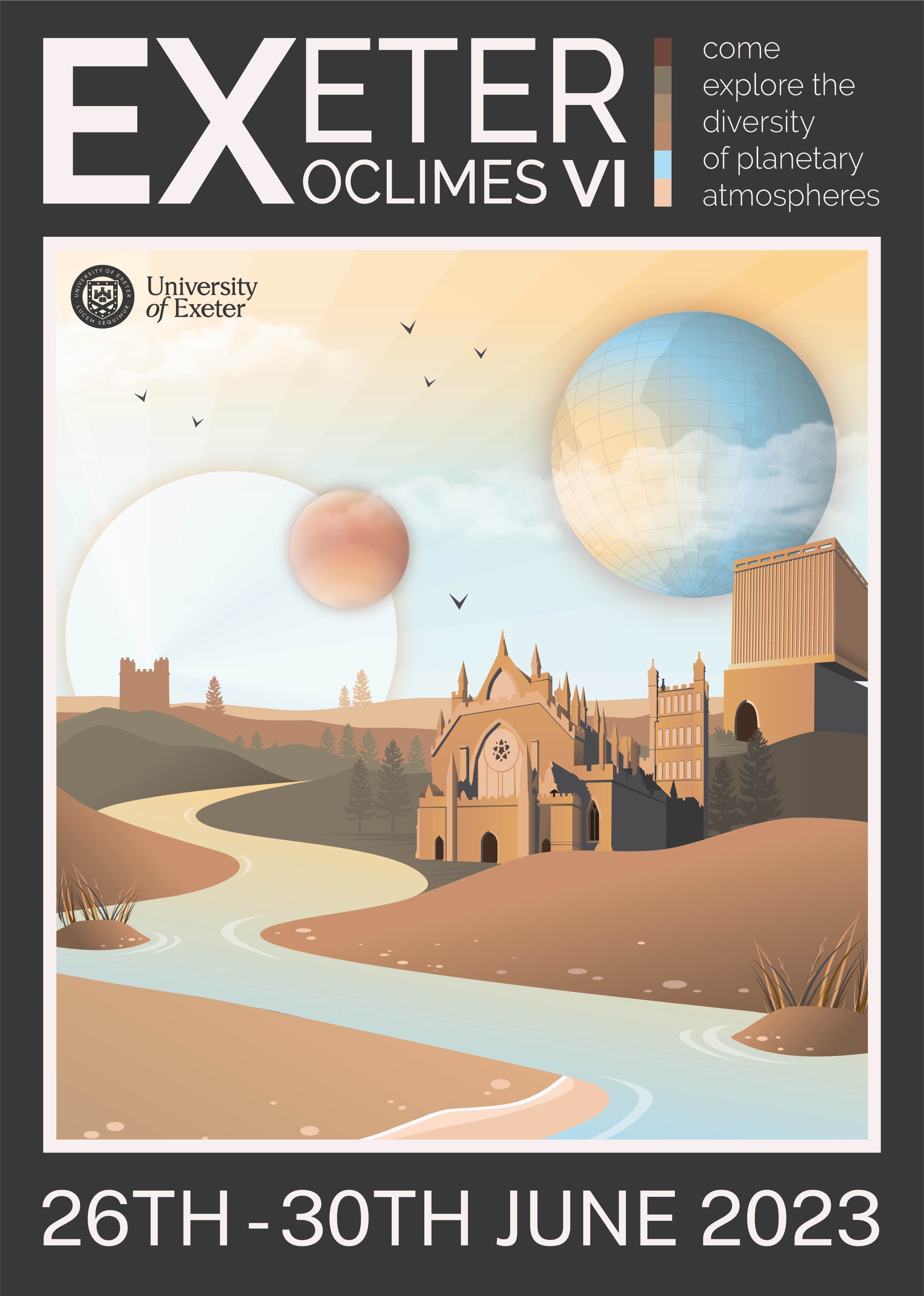
This meeting in Exeter is designed to bring together Earth, Solar System and Exoplanet specialists to discuss recent results and the way ahead, and put our own climate in the wider context of the trials and tribulations of planetary atmospheres.
Important dates
Abstract submission: before May 28th. (Closed)Funding requests: before May 28th. (Closed)
Early Registration: before June 30th. (Closed)
How to register
Follow instructions on the registration page for late registration.
Payment for registration fees, accommodation and meals will be taken via a separate, secure form (see registration page).
Conference themes
Extra-Solar planets
Atmosphere and circulation models of hot gas giantsThe atmosphere-interior connection
Solar System planets
Comparative planetology, Mars, Venus, Earth, TitanBridging the Gap
Applying GCM to exoplanets, toy models, ocean planets,Super-Earths and lava worlds, formation of atmospheres
Living atmospheres
Habitability, atmosphere-life co-evolution, Earth as a system,Climate change
Confirmed Invited Speakers
- Sushil Atreya - University of Michigan
- Peter Cox - University of Exeter
- Linda Elkins-Tanton - Massachusetts Institute of Technology
- François Forget - University of Paris 6
- Jonathan Fortney - University of California Santa Cruz
- David Grinspoon - Denver NH Museum
- James Kasting - Penn State
- Heather Knutson - UC Berkeley
- Tim Lenton - University of East Anglia
- Ralph Lorenz - JHU Applied Physics Lab
- Kristen Menou - Columbia University
- Peter Read - University of Oxford
- Franck Selsis - University of Bordeaux 1
- Adam Showman - University of Arizona
- Fred Taylor - Oxford University
Scientific committee
- Suzanne Aigrain - Oxford University
- Isabelle Baraffe - University of Exeter
- Peter Cox - University of Exeter
- François Forget - University of Paris 6
- Jonathan Lunine - University of Arizona
- Frédéric Pont - University of Exeter
- Adam Showman - University of Arizona
- Christophe Sotin - Jet Propulsion Laboratory
- Fred Taylor - University of Oxford
- Roger Yelle - University of Arizona
Organisers
- Frédéric Pont - University of Exeter
- Suzanne Aigrain - Oxford University
- Isabelle Baraffe - University of Exeter
Local Organising Committee
- Aude Alapini Odunlade (chair)
- Susie Burdett (secretary)
- Frederic Pont
- Suzanne Aigrain
- Jenny Patience (press)
- Nawal Husnoo (website and webcast)
- Joanna Bulger
- Rob De Rosa (webcast)
- Alasdair Allan (internet access)
Conference Motivation
Planetary atmospheres are complex and evolving entities, as mankind is rapidly coming to realise whilst attempting to understand, forecast and mitigate human-induced climate change. In the Solar System, our neighbours Venus and Mars provide striking examples of two endpoints of planetary evolution, runaway greenhouse and loss of atmosphere to space.
The variety of extra-solar planets brings a wider angle to the issue: from scorching 'hot jupiters'' to ocean worlds, exoatmospheres explore many configurations unknown in the Solar System, such as iron clouds, silicate rains, extreme plate tectonics, and steam volcanoes. Exoplanetary atmospheres have recently become accessible to observations.
Additional information
Proceedings
The review talks will be available online as webcasts. No written proceedings will be produced.
Travel grants (Closed)
Some travel grants are available for participants with limited access to travel funding
Fees
The early registration deadline (June 30th) has now passed; the fees have been increased by £40. The conference fees are now £220, as well as an additional fee of £5 to cover transaction costs. The conference fee includes the costs of the conference admission, lunches, refreshments, and conference dinner. Payment on the day will increase by another £40.
Accommodation
On-campus accommodation is available for conference participants at £60 per night.